 Changelly
Changelly is a Wallet-to-Wallet Swap Service with Floating-Rate Risk
Changelly is a wallet-to-wallet exchange - crypto enters from one address and converted crypto exits to another - with floating quotes that move before execution. It sources a conversion through third-party trading services, then deducts the displayed exchange and network costs from the payout. The route removes the need to place an order on an exchange screen, while the final amount on a floating transaction remains exposed to market movement and blockchain-confirmation time.
Published on 30 July 2026
Converting BTC to ETH when both assets stay in separate wallets
A BTC-to-ETH wallet swap is useful when Bitcoin sits in one wallet and the user wants Ether delivered to a separate Ethereum address. The user chooses BTC as the input, ETH as the output, enters the receiving address, reviews a floating or fixed quote, and sends Bitcoin to the newly generated pay-in address.
The route contains 2 on-chain transfers: 1 incoming Bitcoin transaction and 1 outgoing Ethereum transaction. Between them, the service waits for Bitcoin confirmations, passes the received value into its trading-provider chain, executes the conversion, and requests the ETH payout. No order type, bid price, or open position is required, which suits portfolio rebalancing, obtaining an asset needed for network fees, or moving value into a stablecoin such as Tether's USDT. Each step relies on an available pair, functioning deposits and withdrawals, and sufficient venue liquidity.
Floating execution turns confirmation time into price exposure
A floating-rate Changelly exchange treats the displayed output as an estimate until venue execution. Price exposure begins when the quote appears and ends when the trading provider fills the conversion, so every confirmation delay lengthens the interval in which the payout rate moves.
The service describes exchange processing as approximately 5-40 minutes on average, excluding the time needed to confirm the incoming blockchain transfer. Bitcoin block inclusion, the provider's deposit-confirmation rule, venue availability, and the requested withdrawal all sit between the initial estimate and the final wallet credit.
A fixed-rate route removes that market movement from the accepted quote, provided the exact input reaches the designated address within its deadline. The locked output also stays unchanged when the market moves in the user's favor, so fixed pricing exchanges upside participation for amount certainty.
One-time deposit addresses make timing part of the exchange
A one-time deposit address belongs to 1 specific conversion route rather than serving as a permanent wallet endpoint. Floating-rate addresses remain active for 3 hours, while most fixed-rate addresses use a 15-minute window. The fixed window extends to 20 minutes when the input is BTC, XMR, LTC, DCR, EOS, GAS, BNB, or VET - 8 named assets with a longer deadline.
Funds arriving late or at a reused address leave the automatic route and require manual processing or a refund assessment. Failed floating transactions have a published refund window of 1-7 business days after the refund address is confirmed, while a refund involving a reused fixed-rate address is described as taking up to 20 business days. A clean entry path therefore starts with a fresh transaction, the correct pair and network, a verified recipient address, and the exact displayed input amount when the rate is fixed.
Two fee layers reduce the quoted payout in different ways
The Changelly payout combines an exchange charge with an estimated network or withdrawal charge. The first compensates the conversion service; the second covers the provider's cost of sending the output asset across its blockchain, and its value reflects the selected network and the provider's withdrawal conditions.
Floating-rate crypto-to-crypto exchanges carry a 0.25% service fee deducted from the output amount, except when an API partner applies different terms. Fixed-rate pricing uses the displayed locked output rather than that same published percentage formula. The network charge is shown during transaction review, yet its estimate remains tied to the payout route and network conditions.
Worked example - all moving inputs are hypothetical. A user sends a hypothetical 1 LTC, the route produces a hypothetical pre-fee quote of 1,000 DOGE, and the displayed payout network charge is a hypothetical 2 DOGE. The fixed 0.25% floating-rate fee equals 2.5 DOGE, so subtracting 2.5 DOGE and 2 DOGE produces a concrete payout of 995.5 DOGE. These figures illustrate the deductions and do not represent a live LTC/DOGE price.
Network labels decide whether an address is compatible
A token network label identifies the ledger and asset implementation used for the pay-in or payout. USDT exists as an ERC-20 token on Ethereum, a TRC-20 token on Tron, and a BEP-20 token on BNB Smart Chain; the same ticker therefore does not make those transfer rails interchangeable.
Ethereum externally owned accounts and contract accounts use 20-byte addresses, displayed as 40 hexadecimal characters after the 0x prefix, for 42 characters in total. That shared EVM-style format means the address string alone does not distinguish Ethereum from BNB Smart Chain; the selected network supplies the missing context. XRP Ledger payments may require a 32-bit unsigned destination tag, while Stellar supports a 64-bit memo ID, memo text up to 28 bytes, and 32-byte hash memos. An omitted or mismatched extra ID prevents automatic attribution to the intended exchange request.
The quote engine connects wallets to third-party liquidity
The quote engine acts as an intermediary among a sender's wallet, external trading services, and a recipient's wallet. The published terms identify Marella LLC and its affiliates as the operator, while the standard exchange route sends funds through third-party services instead of matching an order inside a user-funded trading balance.
Changelly launched in April 2015 with support for 30 cryptocurrencies and developed around rate sourcing from multiple trading platforms. A modern transaction still follows that durable mechanism: collect a pair and amount, estimate a route, create a single-use address, wait for the pay-in, execute through available liquidity, and dispatch the result. "Wallet-to-wallet" describes the endpoints. During the middle stage, the platform and its providers direct the conversion until the outgoing blockchain transaction is submitted.
Embedded wallet swaps preserve the same provider chain
An embedded wallet swap begins inside a wallet interface, although the named exchange provider still supplies the quote and executes the route. Ledger, Trezor, Exodus, and MyEtherWallet are established examples of wallets that have carried this integration, reducing interface changes without turning the wallet manufacturer into the trading venue. The transaction record therefore contains 2 different identifier classes: a service-specific transaction ID for the internal route and blockchain hashes for the on-chain transfers. The documented workflow uses 10 status labels - Created, Waiting for payment, Hold, Confirming, Exchanging, Sending, Finished, Failed, Not paid, and Expired - to show which dependency currently controls progress.
Identity review can interrupt an otherwise automatic route
An identity review inserts a compliance decision before an exchange resumes. Changelly applies risk scoring to particular transactions and requests Know Your Customer material when a route is selected for review, even though many crypto-to-crypto requests begin without advance verification.
The verification set has 3 core evidence classes: an identity document, a face image or video associated with that document, and source-of-funds material when requested. The ID must remain valid for at least 1 month from submission, and the stated verification target is no more than 24 hours, although reviews involving additional parties extend beyond that target. Account eligibility begins at age 16 or the higher legal age in the relevant jurisdiction. For account login, Google Authenticator supplies a 6-8-digit two-factor code on a 30-second cycle, while the verification interface uses Sumsub for document submission.
Short conversions suit the model better than active trading
A short asset conversion fits this model when the user already controls compatible sending and receiving wallets, the pair has active liquidity, and the objective is an immediate change of asset rather than a precisely staged entry. Examples include converting BTC to ETH, moving LTC into USDT, or obtaining ETH needed for an Ethereum transaction. A fixed quote fits a payout obligation denominated in exact units; a floating quote fits a user who accepts movement between estimate and execution. Repeated limit orders, partial fills, chart-based entries, and long-lived balances belong to an order-book workflow with direct price controls.
Order books and on-chain pools change who controls execution
An order-book exchange lets the user specify price and execution conditions, while an automated market maker executes from a connected wallet against smart-contract liquidity. These alternatives redistribute custody, fee payment, route visibility, and fill control rather than merely presenting another version of the same wallet-to-wallet mechanism.
Coinbase Advanced supplies account-based order books and limit orders; Kraken also centers trading on deposited balances and explicit orders. Uniswap executes through Ethereum and other supported EVM networks, with the wallet signing token approvals and swaps while gas and pool price impact affect settlement. ChangeNOW occupies the closer comparison category because it also offers address-to-address conversions without requiring the user to manage an order book. The decisive distinction is mechanical: order books expose price controls, Uniswap exposes on-chain pool execution, and an instant exchange provider packages venue selection and cross-chain payout into one request.
Helpful answers about Changelly
-
Can I cancel a swap after funds have left my wallet?
- A submitted blockchain payment cannot be treated as a cancellable card transaction. Before sending funds, the unused request can simply expire. After the pay-in leaves the wallet, cancellation depends on whether the conversion and payout have progressed far enough to stop; support must examine the transaction. Once the outgoing asset has been sent to the recipient address, the completed transfer is irreversible.
-
Do I need an account to exchange crypto?
- Some crypto-to-crypto exchanges can begin without a logged-in account, particularly through supported app or partner flows. An account preserves transaction history and simplifies access to support records, while full platform functionality requires registration and a verified email. Starting without an account does not remove compliance screening, so an individual transaction can still be placed on hold for identity verification.
-
Is a Changelly transaction ID the same as a blockchain hash?
- A Changelly transaction ID and a blockchain hash identify different records. The service ID tracks the complete conversion inside the exchange system, including its status and selected pair. A blockchain hash identifies one on-chain transfer, such as the incoming deposit or outgoing payout. One swap can therefore involve a service ID plus separate hashes from two different networks.
-
Are bank-card purchases processed by the same exchange route?
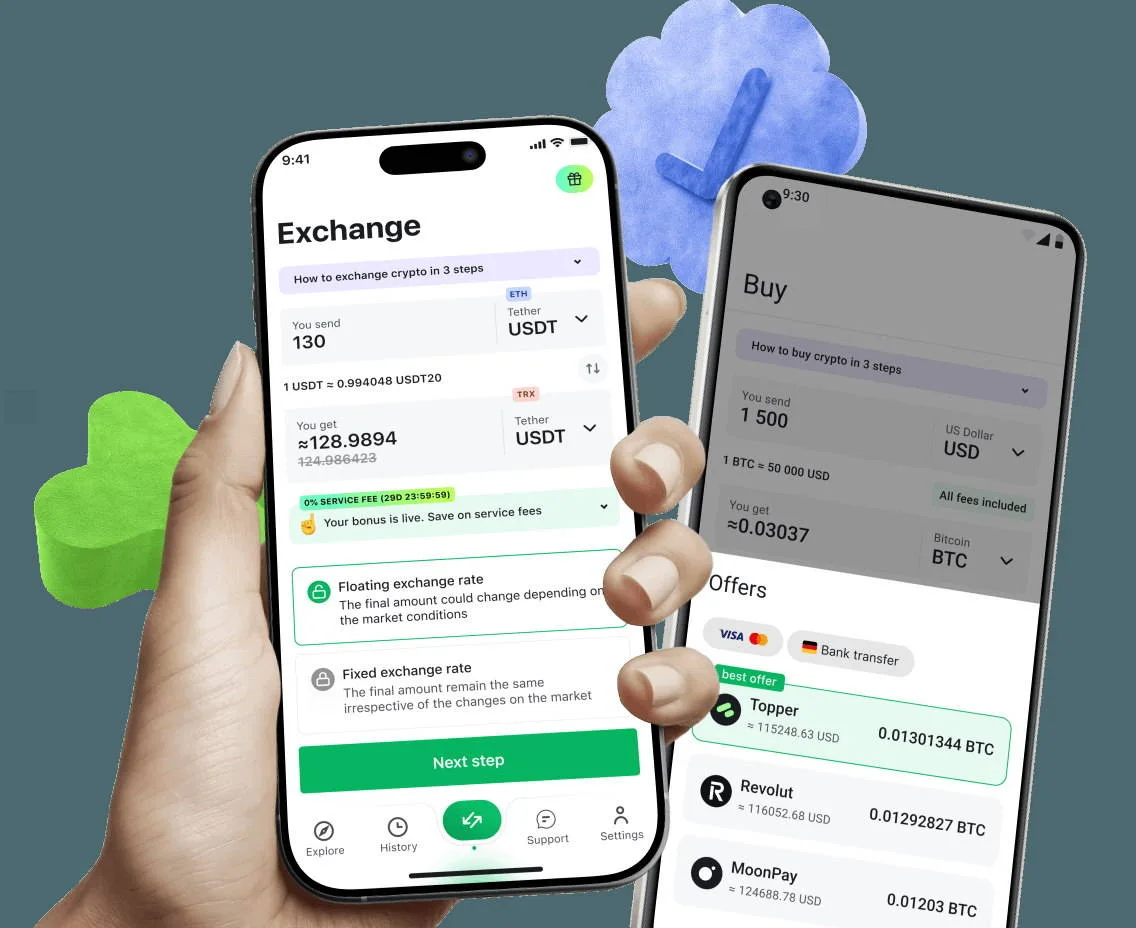
- Bank-card purchases use a fiat marketplace and a selected payment provider rather than the standard crypto-to-crypto route alone. The provider handles payment processing, identity requirements, purchase limits, applicable charges, and asset delivery under its own workflow. The marketplace presents available offers, while the resulting crypto is sent to the recipient wallet entered during checkout.
-
Can one swap pay out to two recipient addresses?
- One standard swap records one recipient address for its outgoing asset. The generated pay-in address, chosen pair, and recipient address are bound together as a single transaction request, so the resulting payout is not divided between multiple destinations. Sending output to two wallets requires two separately created exchanges, each with its own quote, deposit instruction, network charge, and transaction ID.