 Changelly
Changelly fees are a 0.25% floating-rate charge plus network costs
Changelly fees are built from a 0.25% service charge on floating-rate output and a separate network fee reflected in the quoted receive amount. The percentage belongs to Changelly; the network component covers moving the acquired asset to the destination wallet and changes with the asset, blockchain, and route. A sending wallet or exchange may also charge for the incoming transfer, so compare the amount finally received with the amount that actually leaves the source account.
Published on 1 August 2026
Do not treat 0.25% as the all-in swap cost
The common mistake in reading Changelly fees is assuming that 0.25% describes every deduction between the source account and destination wallet. It describes one service charge within a two-layer floating-rate quote: Changelly's percentage and the estimated output network fee. The transfer into Changelly creates a third economic cost when a wallet pays blockchain fees or an exchange subtracts a withdrawal charge.
Those three movements use different assets and pay different parties. Sending BTC from a Bitcoin wallet consumes a miner fee in BTC, while sending an ERC-20 token from Ethereum requires ETH for gas. A Solana token transfer uses SOL for its source-chain transaction. If Kraken or another custodial platform is the sender, its withdrawal charge determines how much reaches the one-time pay-in address; this matters especially when a fixed-rate order requires the exact displayed input.
Who receives each charge in a floating-rate exchange?
A floating-rate Changelly exchange separates the service fee from the network allowance used to deliver the output asset. Changelly receives the 0.25% service charge, while the output network component funds settlement through the relevant exchange and blockchain infrastructure. Miners or validators process the blockchain transfer, although the amount shown to the user is an estimate established through Changelly's execution route.
- Service fee: Changelly deducts the percentage from the output amount.
- Output network fee: the quote accounts for sending the acquired asset to the recipient address.
- Source transfer cost: the wallet or sending exchange charges this outside the Changelly quote.
- Rate movement: no party receives it as a fee; it changes the conversion result under floating pricing.
Three cost categories therefore surround one swap, but only two belong to Changelly's displayed fee structure. Its C2C API exposes four relevant labels - changellyFee, networkFee, totalFee, and apiExtraFee - which also explains why an embedded partner quote need not match the direct interface.
How network choice reshapes the final quote
Network choice changes Changelly's network estimate because each blockchain prices settlement through its own units and rules. Ethereum charges gas, Bitcoin prices transactions by their encoded size and fee rate, and Solana combines a signature-based base fee with an optional prioritization fee. None of those mechanisms is another percentage charged by Changelly.
A plain ETH transfer consumes 21,000 gas, while an ERC-20 transfer invokes token-contract code and therefore has no universal 21,000-gas total. One gwei equals one billion wei, and 1 ETH contains 10 18 wei. On Solana, the base fee is 5,000 lamports per signature before any optional priority fee, while 1 SOL contains one billion lamports. These constants define the units; live demand determines the resulting asset cost.
Token precision affects how the deduction is displayed. Circle's USDC uses 6 decimal places, so one whole USDC equals one million subunits. Tether's USDT ERC-20 on Ethereum and USDT TRC-20 on TRON share a ticker but use separate settlement rails. A network mismatch is an operational error rather than a fee saving, so every quote comparison must preserve the same token standard and recipient network.
Floating and fixed quotes use different fee logic
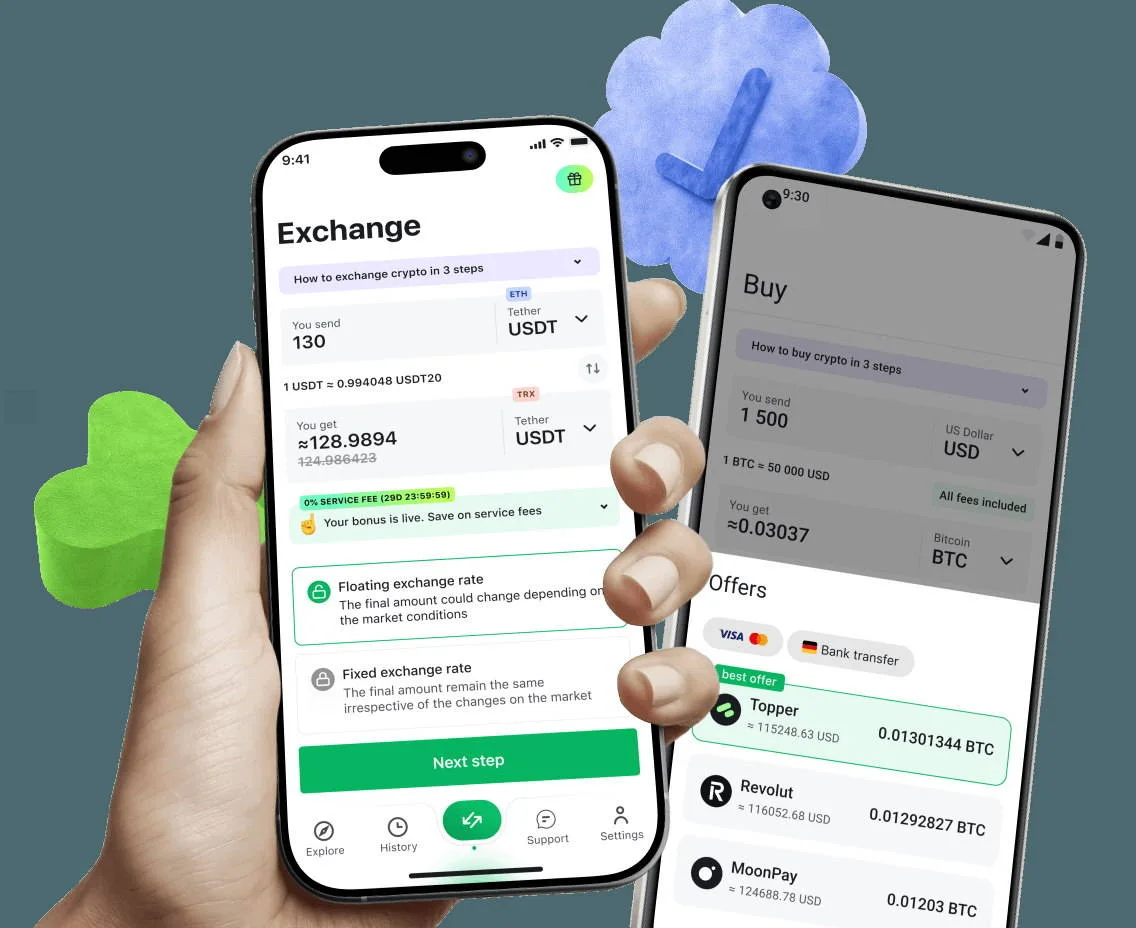
Changelly's floating and fixed modes price uncertainty differently. A direct floating swap publishes the 0.25% service component and a network estimate, while its exchange rate continues moving during execution. A fixed quote embeds a dynamic protection cost in the displayed rate instead of presenting the same 0.25% formula.
| Quote mode | Fee treatment | Payment window |
|---|---|---|
| Floating | 0.25% service fee plus an estimated network fee | Pay-in address remains active for 3 hours |
| Fixed | Dynamic cost embedded in the locked output quote | 15 minutes, or 20 minutes for specified assets |
The 3-hour floating-address window is not a 3-hour rate lock. Fixed pricing instead locks the quoted amount for 15 minutes, with a 20-minute window for eight specified input assets: BTC, XMR, LTC, DCR, EOS, GAS, BNB, and VET. Bitcoin, Monero, Litecoin, Decred, EOS, BNB, and VeChain therefore appear in the longer-window group under their respective tickers. Sending the displayed amount within the applicable window preserves the fixed-order terms.
The output-based formula behind the service charge
The output amount, rather than the number of input coins, is the basis for Changelly's direct floating-rate calculation. A direct floating-rate swap deducts a 0.25% Changelly service fee from the output amount. In decimal form, the multiplier is 0.0025.
Consider a unit-free hypothetical in which market conversion produces 10,000 output units before service and network deductions. Multiplying 10,000 by 0.0025 gives a 25-unit service fee. If the separately displayed output network estimate were 4 units for that quotation, the destination amount would be 10,000 − 25 − 4 = 9,971 units. The 4-unit assumption illustrates the arithmetic; it is not a live blockchain fee.
The same percentage takes 2.5 units from 1,000 units, or 1 unit from every 400 output units. Network cost does not follow that ratio, which is why small exchanges show a higher effective cost when measured against the amount received. Floating-rate movement also belongs outside this fee calculation: it changes the conversion base before the percentage is applied.
Comparing Changelly with order books and on-chain routes
A fair Changelly quote comparison uses the final destination amount for the same input, pair, network, and measurement window. Comparing advertised percentages alone mixes incompatible cost models: an instant exchange quote, a centralized order-book trade, and a decentralized exchange transaction expose different pieces of the route, which is examined in detail.
In most cases, Changelly combines conversion and delivery in one quoted workflow. Kraken Pro separates an order-book trading fee from the later crypto withdrawal charge, creating at least two priced steps. Uniswap v3 executes from a connected wallet through a liquidity pool; its four established fee tiers are 0.01%, 0.05%, 0.30%, and 1.00%, while the wallet pays Ethereum gas separately. The 1inch aggregator searches decentralized liquidity routes and may split one swap across multiple venues, with the user's wallet funding the on-chain transaction.
Record the source debit and destination credit for all four approaches, keeping the recipient chain identical. A USDC quote delivered over Ethereum is not directly comparable with one delivered over Solana, even when both display the same ticker and decimal precision. The service with the largest credited output after every required transfer has the lower effective cost for that specific quotation.
Small swaps, partner integrations, and product boundaries
Small Changelly swaps feel disproportionately expensive when the output network estimate consumes a larger share of the received amount. The 0.25% component remains linear - doubling the pre-fee output doubles that service deduction - but the network allowance does not scale by the same ratio. Changelly's minimum exchange amount therefore has to cover both the relevant network estimate and the market's minimum executable lot.
Partner integrations form another edge case. Changelly's direct 0.25% floating-rate policy does not guarantee the same charge through every API partner, and the C2C schema contains four fee fields so an integration can represent an extra partner percentage. An embedded quote inside Ledger or Exodus should be evaluated as its own offer, using the exact amount sent and the amount scheduled for delivery.
Fiat products use a separate structure. Card-purchase providers establish their own charges, while Changelly lists a 3.95% minimum for crypto-to-fiat sales rather than applying the crypto-swap percentage. Before confirming any route, capture the input amount, destination asset and network, final receive estimate, source withdrawal cost, and quote mode. Those figures expose the complete cost without treating market movement as a hidden fee.

Changelly fees: the short answers
Is the 0.25% Changelly charge applied once or to both coins?
The direct floating-rate service charge is applied once to the output amount, not separately to both assets. The source transfer fee and the output network estimate are separate blockchain-related costs, which creates multiple deductions around one Changelly service fee. Starting another swap creates a new 0.25% charge because it is a separate exchange transaction.
Can network congestion change the quoted cost after I create a floating order?
Yes, network congestion changes the estimated output transfer cost, and a floating market rate continues moving until execution. Changelly displays an estimate when the transaction is created, while the network portion can differ when settlement occurs. The 0.25% service percentage remains unchanged for a direct floating-rate swap, so compare the final credited amount with the original source debit.
Are card-purchase charges covered by the 0.25% crypto-swap fee?
No, card purchases run through fiat providers that establish their own charges and exchange terms. The 0.25% figure belongs to direct crypto-to-crypto floating-rate swaps, while a card quote combines provider charges, payment processing, and the selected crypto amount. Compare the final crypto delivery amount rather than carrying the swap percentage into a fiat purchase.
Does a Changelly refund include the original blockchain fees?
A refund does not restore blockchain fees already paid for confirmed transfers. Changelly also deducts applicable network or operating costs from a manual refund when those costs arise, with the amount and processing path determined by the reason the exchange could not complete. Evaluate a refund against the refundable asset amount rather than the original source-account debit.
Will repeat customers receive a lower floating-rate service charge?
Changelly does not publish a direct floating-rate loyalty or volume tier that reduces the 0.25% service percentage for ordinary users. A larger swap reduces a fixed network deduction as a proportion of value, yet the service charge remains proportional to output. API partner arrangements use different terms, so an embedded quote is a separate pricing case rather than a repeat-customer discount.
Are USDT-to-USDC swaps free because both are stablecoins?
No, a USDT-to-USDC swap still carries the Changelly service charge under floating-rate pricing and an output network estimate. Stable price targets do not remove blockchain settlement costs, and the selected token standard matters: ERC-20 uses Ethereum, while TRC-20 uses TRON. Quote comparisons must keep the same USDT and USDC network variants across every service.